

 keith
keith
I was looking over my reading and writing routines. Minimums for the fram are Clock high min. 28ns Clock low min. 28ns Data setup min 5ns I write in two places: First, when bits are coming in from the drive, and the ISR...
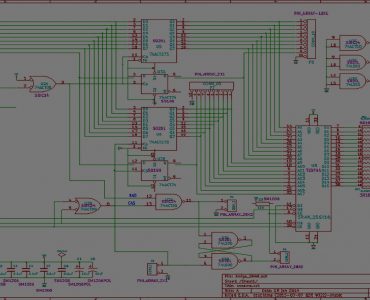
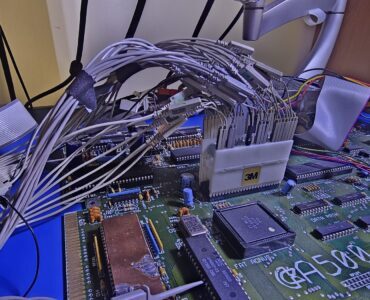
I was looking over my reading and writing routines. Minimums for the fram are Clock high min. 28ns Clock low min. 28ns Data setup min 5ns I write in two places: First, when bits are coming in from the drive, and the ISR...
It looks as if I spoke too soon. I’m still having reading problems. The data used to be forced into an MFM mold, but all that’s done in some cases, is to further corrupt the corrupt data. I rewrote my ISR...
I plan to create a separate section for these type of documents, but I wanted to get this online for now. I purchased the Samsung (made by SEMA, the division split off of Samsung that mostly makes floppy drives) SFD...
OK Great news. As I stumbled on in the last post: I’ve fixed my reading issues, and I’m now reliably reading, in one shot, an entire amiga track from the unmodified standard PC drive!! When seeing double...
It seems as though when I have a read problem, its normally minor, and is a single bit error. I notice that the errors have a tendency for 0s to be incorrectly interpreted as 1s. So I get AB instead of 2B, AB instead of...
OK, I’ve applied the “double 1’s” fix that I talked about earlier today. This definitely helped things. I think my results are quite possibly the best I’ve seen them yet. Now, my SX...
While I shouldn’t be surprised, my SX hardware issue is related to double one’s, where the SX sees transitions back to back, and writes back to back 1’s into memory. This is assuming there aren’t...
Despite having a couple different official sources, both AFR.c and floppy.c from the fellow amiga emulator says that the even bits come before the odd bits. This is true in the sector header decoding as well as in the...
While I’m hesitant to post this at all, this is a quick and dirty application I threw together, and I do mean threw, that will check for valid MFM bytes. See the previous post for the link to the actual bytes. It...
I wanted to put up some example files. Note that a preceding “D” for dump and two delimiting 0xFF’s might exist in these files. Also an ending 0xFF 0xFF might exist. So two bad files below have exactly...
Well, I’ve put a decent number of hours in on the project over the last couple weeks. I’ve mostly been “spinning my wheels” because I haven’t made much progress, but I think I’ve...
Welp, I decided to take a look at my code today, although I can’t actually implement anything until after I get home from work. 🙂 Not sure if I mentioned this eariler, but I’m now padding the data sent from...
Ok. A post or two back, I mentioned that I wanted to rework the receive UART because it wasn’t working perfect. I fixed that, and now it’s reliably receiving. I also mentioned that my sending uart code was...
So you’ve seen me talk about good data and bad data. But what’s the difference? Good data looks like the picture I posted awhile back here. Note the very even spread of 4—4—8. Every pattern is...
I’ve been horrible about the project lately. Dunno why. Today is the first time I’ve looked at it in quite some time. The last couple hours have been spent trying to remember exactly where I’ve been...
As you can see above, we have a “10” (4 us), another “10”(4 us) and a “1000”(8 us) chunks of data. Little noisy there.
well I’ve got MFM flowing from the PC drive now. A couple of things: Pins 10 and 14, the pins I’ve been using since last night, appear to be correct. Pin 10 is the motor lead. Dropping a corresponding SX...
Welp, I’ve ordered a new, but cheap ($5.99!) regular PC floppy drive from newegg.com. I like this end result much better anyways. PC drives are much more available, popular, cheap, and so on. was worried about...

techtravels.org is a blog that features home-grown open-source hardware and software projects.
Copyright © 2025 techtravels.org Powered by WordPress